
 Listen to this great interview with Dr. Bernadette Murphy. This is an interview that all chiropractors and students will want to listen to! We talk about many interesting concepts such as the current state of neurophysiology research within chiropractic, neural adaptation in humans and the role of chiropractic adjustments in aiding the re-establishment of appropriate neuromuscular connections, how a chiropractic adjustment works and much more. She is at the forefront of research regarding the neurophysiology of chiropractic. Dr. Murphy graduated from Queens University in 1985 and the Canadian Memorial Chiropractic College in 1989 before moving to New Zealand where she completed her MSc (1992) and PhD (1998) in Human Neurophysiology at the University of Auckland. She was a fulltime faculty member in the Department of Sport and Exercise Science from 1999-2007, where she established an MSc in Exercise Rehabilitation. In January 2008, she returned to Canada and took on the role of Head of Kinesiology in the Faculty of Health Sciences at the University of Ontario Institute of Technology (UOIT). She is the Director of the Human Neurophysiology and Rehabilitation Laboratory. The overall theme of her research is neural adaptation in humans and the role of physical interventions such as spinal manipulation and exercise in aiding the re-establishment of appropriate neuromuscular connections. She has previously been awarded the World Federation of Chiropractic best scientific paper award (1995) and 3rd prize in 2007; the New Zealand Chiropractor of the year (2004) and the 2010 Ontario Chiropractic Association award for most significant contributions to research. She has supervised numerous award winning Masters and PhD students and received significant research funding in New Zealand, Australia and Canada.
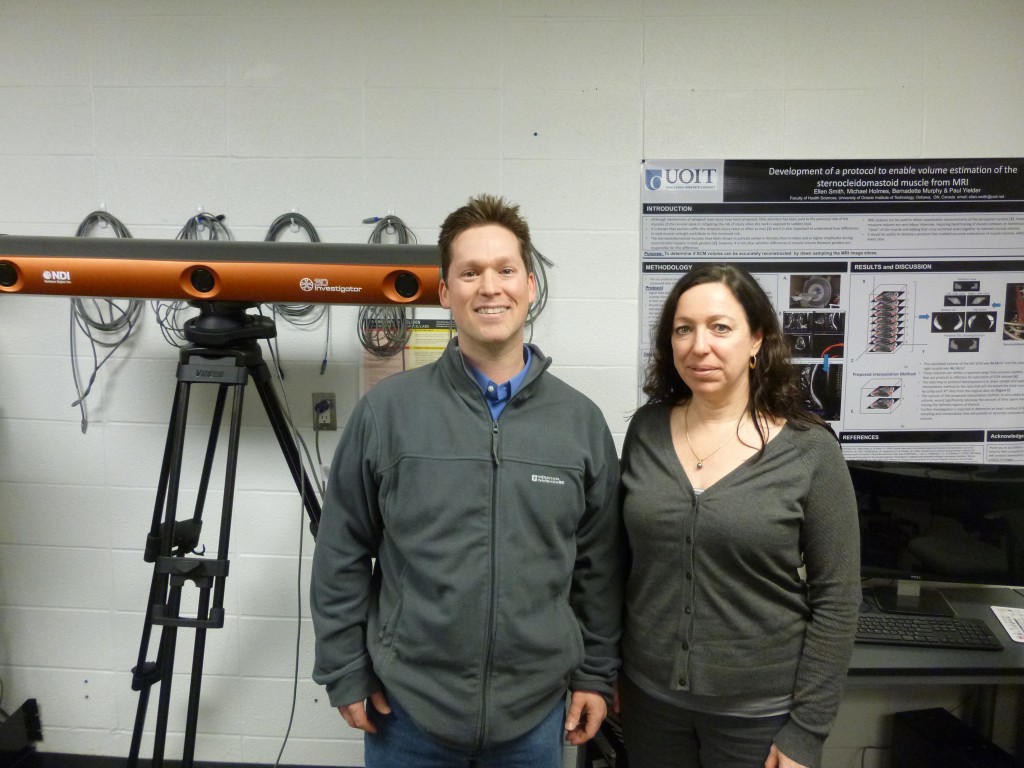
Dr. Murphy and Dr. Smith at University of Ontario Institute of Technology
View Dr. Murphy’s research at researchgate.net.
Articles that we talk about in this episode include:
|
1.
|
The impact of cervical manipulation on heart rate variability.
Annu Int Conf IEEE Eng Med Biol Soc. 2014;2014:3406-9. doi: 10.1109/EMBC.2014.6944354.
PMID: 25570722 |
|
2.
|
The role of spinal manipulation in addressing disordered sensorimotor integration and altered motor control.
J Electromyogr Kinesiol. 2012 Oct;22(5):768-76. doi: 10.1016/j.jelekin.2012.02.012. Epub 2012 Apr 6.
PMID: 22483612 Review. |
|
3.
|
Alterations in cortical and cerebellar motor processing in subclinical neck pain patients following spinal manipulation.
J Manipulative Physiol Ther. 2013 Oct;36(8):527-37. doi: 10.1016/j.jmpt.2013.08.003. Epub 2013 Sep 12.
PMID: 24035521 |
|
4.
|
Subclinical neck pain and the effects of cervical manipulation on elbow joint position sense.
J Manipulative Physiol Ther. 2011 Feb;34(2):88-97. doi: 10.1016/j.jmpt.2010.12.009.
PMID: 21334540 |
|
5.
|
Altered central integration of dual somatosensory input after cervical spine manipulation.
J Manipulative Physiol Ther. 2010 Mar-Apr;33(3):178-88. doi: 10.1016/j.jmpt.2010.01.005.
PMID: 20350670 |
|
6.
|
Altered sensorimotor integration with cervical spine manipulation.
J Manipulative Physiol Ther. 2008 Feb;31(2):115-26. doi: 10.1016/j.jmpt.2007.12.011.
PMID: 18328937 |